
This product is no longer available; a good alternative is the Rhotheta RT-300.
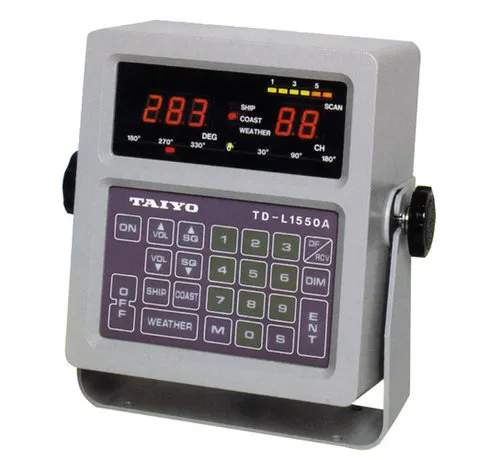
The Taiyo TD-L1550A is a professional automatic digital VHF direction finder designed for marine applications. It receives radio transmissions and determines the direction from which the signal is arriving. It supports international VHF channels, US weather or Scandinavian fishing channels and the 121.5 MHz distress frequency.
The incoming signal bearing is displayed relative to the vessel's bow. Two indication methods are provided: a numerical digital bearing display with 1° resolution and a linear LED indicator for rapid visual recognition.
The TD-L1550A supports manual, spot and scanning reception. Up to 100 channel/station combinations can be stored, while scanning supports up to 10 groups containing as many as 10 channels each.
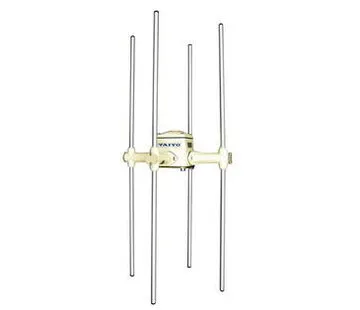
Direction finding is performed using an H-type four-element EA-351A Adcock antenna. The original documentation specifies 10–16 V DC operation, main-unit dimensions of approximately 213 × 205 × 95 mm and a weight of about 2.7 kg.
Key features
• Automatic digital VHF direction finder
• Designed for professional marine applications
• International VHF channel reception
• US weather or Scandinavian fishing channels
• 121.5 MHz distress-frequency reception
• Digital bearing indication in 1° increments
• Linear LED bearing indicator
• Six-level signal-strength indication
• Manual reception
• Spot reception
• Automatic scanning
• Memory for up to 100 channel/station combinations
• Up to 10 scan groups
• Up to 10 channels per scan group
• PLL synthesizer
• Four-element Adcock antenna
• 2 W audio output into 4 ohms
• 10–16 V DC operation
• Optional NMEA 0183 bearing-data output
Product specifications
• Brand: Taiyo
• Manufacturer: Taiyo Musen Co., Ltd.
• Also marketed as: Simrad Taiyo
• Model: TD-L1550A
• Alternative designation: TD-L1550
• Product type: automatic digital VHF direction finder / RDF / ADF
• Application: determining the bearing of received marine radio signals
• Frequency applications: international VHF, weather/fishing channels and 121.5 MHz
• Distress frequency: 121.5 MHz
• Emission types: F3E; A3E on 121.5 MHz
• Receiver type: double superheterodyne with PLL synthesizer
• Intermediate frequencies: 21.4 MHz and 455 kHz
• Sensitivity: 0.5 µV/m at 12 dB SINAD, excluding 121.5 MHz
• Image rejection: 55 dB or greater, excluding 121.5 MHz
• Selectivity: -6 dB at ±5 kHz and -40 dB at ±12.5 kHz
• Bearing display: numeric and linear
• Digital bearing resolution: 1°
• Linear bearing display: 10°, 20° or 30° steps
• Signal-strength display: 6 levels
• Station indicators: Ship, Coast, Weather/Fishing and EPIRB 121.5 MHz
• Memory capacity: 100
• Scan groups: maximum 10
• Channels per group: maximum 10
• Audio output: 2 W at 4 ohms
• Standard antenna: Taiyo EA-351A
• Antenna type: H-type four-element Adcock
• Supply voltage: 10–16 V DC
• Grounding: negative ground
• Optional AC operation: via adapter
• Main-unit dimensions: approximately 213 × 205 × 95 mm
• Main-unit weight: approximately 2.7 kg
• Operating temperature: approximately 0 to 45 °C
• NMEA 0183: optional bearing-data output